

November Homeschool Themes & History Studies: Meaningful Learning Ideas for Elementary Ages
Inside: Explore 10 November homeschool themes and history studies for elementary kids, including Thanksgiving, Remembrance Day, animal migration, seasonal science, and more.
November is a wonderful month to explore history, seasonal changes, traditions, and the world around us. As the days grow shorter and the weather begins to change, there are plenty of opportunities to bring learning to life through stories, historical events, nature studies, and hands-on activities.
Whether you’re planning a November homeschool unit, looking for fresh classroom themes, or simply wanting to add a little seasonal learning to your regular routine, November offers a variety of interesting topics for elementary-aged children.
From exploring the history of Thanksgiving and learning about Remembrance Day to studying weather patterns, migration, and cultural traditions, there’s no shortage of ways to make November educational and engaging.
Here are some November themes and history studies worth exploring, along with ideas for connecting them to reading, writing, science, geography, and creative activities.

Thanksgiving: History, Traditions & Gratitude
Thanksgiving is one of the most recognizable November themes, particularly in the United States. It’s also an opportunity to explore history, cultural traditions, agriculture, and the meaning of gratitude.
An elementary Thanksgiving study can go well beyond turkeys and festive decorations. Children can investigate the history of the 1621 harvest gathering, learn about the Wampanoag people, and explore how Thanksgiving traditions have changed over time.
Learning activities to try:
- Create a timeline showing important events in Thanksgiving history.
- Compare daily life in the 1600s with life today using a Venn diagram.
- Research the journey of a Thanksgiving food from farm to table.
- Explore harvest traditions in different countries.
- Write a short story about a historical gathering from the perspective of a child living during that period.
- Create a gratitude journal or write notes of appreciation for family and friends.
A Thanksgiving unit study is an excellent way to combine history, social studies, reading, writing, and science into one connected learning experience. *Just completely updated in 2026.*
Note: Canadian Thanksgiving takes place in October, while American Thanksgiving falls in November. The historical study of Thanksgiving and harvest traditions can still be explored throughout the fall, regardless of where you live.

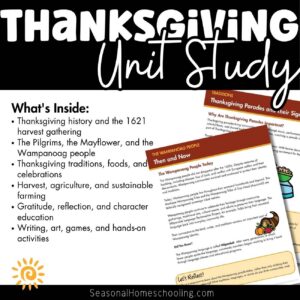
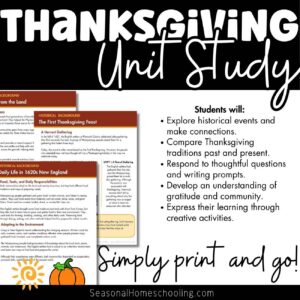
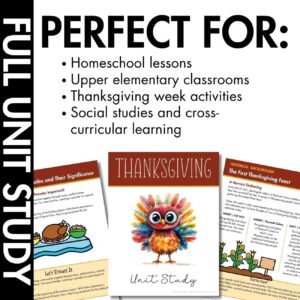


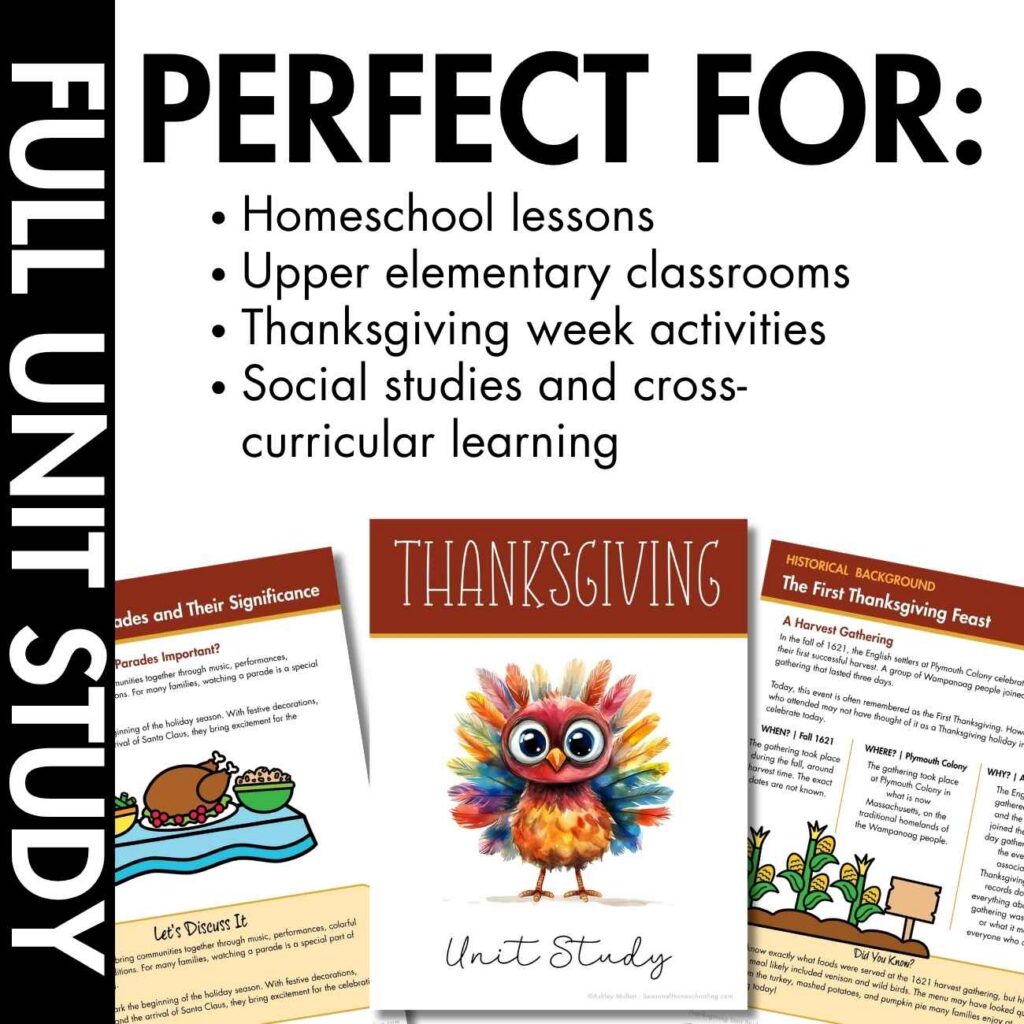
Thanksgiving Unit Study for 3rd, 4th, 5th Grade | Activities & Learning
This Thanksgiving unit study gives grades 3–5 students a real look at the history, traditions, and meaning behind the holiday through readings, activities, and reflection. They’ll explore the Pilgrims, the Wampanoag people, the 1621 harvest, modern Thanksgiving traditions, gratitude, and Indigenous farming practices like the Three Sisters method.
It’s 70 pages of actual content, not filler.
Remembrance Day & Veterans Day: Exploring History Through Stories
November 11 is an important date in many countries. In Canada and other Commonwealth countries, it is observed as Remembrance Day. In the United States, it is Veterans Day.
Both observances provide opportunities to introduce elementary-aged children to the history of military service, the First and Second World Wars, and the importance of remembering those who served.
These topics can feel complicated for younger learners, so the focus should be on age-appropriate historical understanding, remembrance, service, and peace rather than graphic details of war.
Some topics to explore include:
- What was World War I?
- Why was November 11 chosen as a day of remembrance?
- What is the significance of the poppy?
- What was life like for children during wartime?
- How did communities support soldiers and their families?
- What is the difference between Remembrance Day and Veterans Day?
Learning activities to try:
- Create a simple timeline of World War I and World War II.
- Read age-appropriate historical stories about children living during wartime.
- Research the symbolism of the red poppy.
- Write a letter of appreciation to a veteran or service member.
- Explore historical photographs and compare life during wartime with life today.
- Locate countries involved in the World Wars on a world map.
For younger children, simple discussions about remembering, helping others, and appreciating peace can provide a meaningful introduction to the subject.
Indigenous History & Culture
November offers an opportunity to explore Indigenous history and cultures, particularly when studying Thanksgiving, North American history, and the relationship between people and the land.
In the United States, November is Native American Heritage Month. In Canada, Indigenous history and learning are important year-round, with November also including Indigenous Veterans Day on November 8.
Rather than treating Indigenous peoples as a single group with one shared culture, children can begin discovering the many distinct First Nations, Inuit, and Métis communities in Canada, as well as the diverse Native American nations across the United States.
Some topics to explore include:
- Traditional homes and communities.
- Indigenous languages and storytelling traditions.
- Food, farming, fishing, and hunting practices.
- Relationships with the natural environment.
- Historical contributions and innovations.
- Indigenous communities and cultures today.
Learning activities to try:
- Locate different Indigenous communities on a map.
- Explore traditional homes and how they were adapted to local environments.
- Read books by Indigenous authors.
- Learn about traditional foods and their importance.
- Research an Indigenous invention, innovation, or historical contribution.
- Compare how different communities adapted to their geographic surroundings.
Choose resources created by Indigenous authors, educators, and communities whenever possible. This helps children learn from authentic perspectives and understand that Indigenous cultures are living, diverse, and continually evolving.
Day of the Dead: Exploring Cultural Traditions
Observed on November 1 and 2, Día de los Muertos, or Day of the Dead, is a Mexican tradition that honors and remembers loved ones who have passed away.
It offers an opportunity to explore Mexican culture, family traditions, history, and the ways different communities remember those who came before them.
Children can learn about the meaning behind some of the traditional symbols and celebrations, including:
- Ofrendas (altars created to honor loved ones).
- Marigold flowers.
- Photographs and treasured family objects.
- Traditional foods.
- Music and colorful decorations.
Learning activities to try:
- Locate Mexico on a map and explore its geography.
- Learn about the history and cultural influences behind Día de los Muertos.
- Explore the symbolism of marigold flowers.
- Read children’s books that introduce the celebration respectfully.
- Compare remembrance traditions in different cultures.
- Create a family history page celebrating the stories of relatives and ancestors.
It’s important to explain that Día de los Muertos is not simply a Mexican version of Halloween. It is a meaningful cultural tradition centered on family, remembrance, and honoring loved ones.

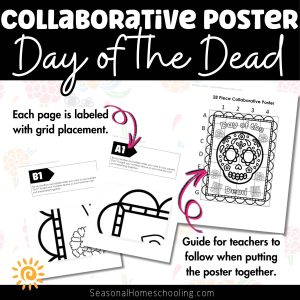
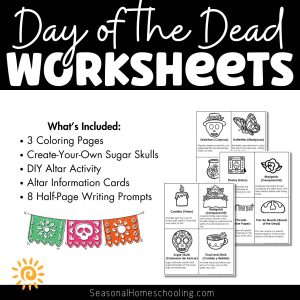
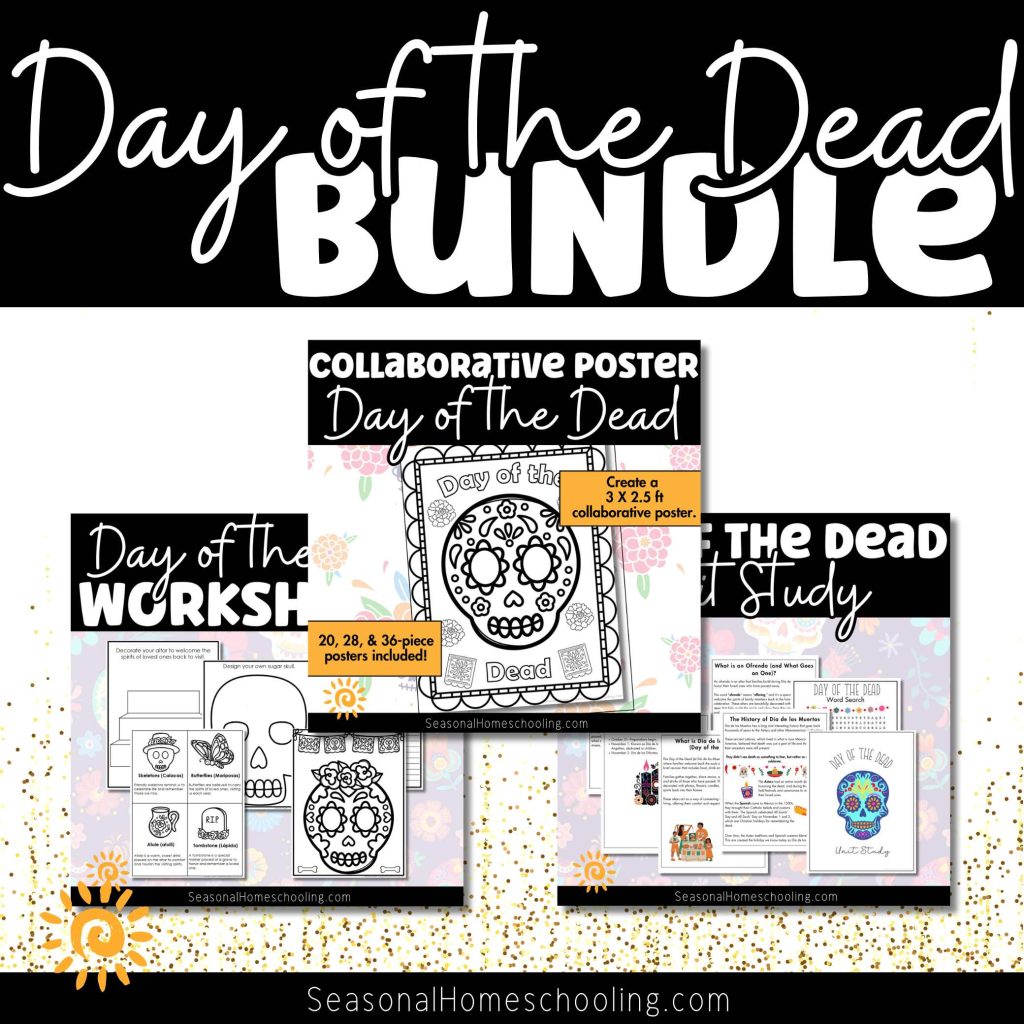
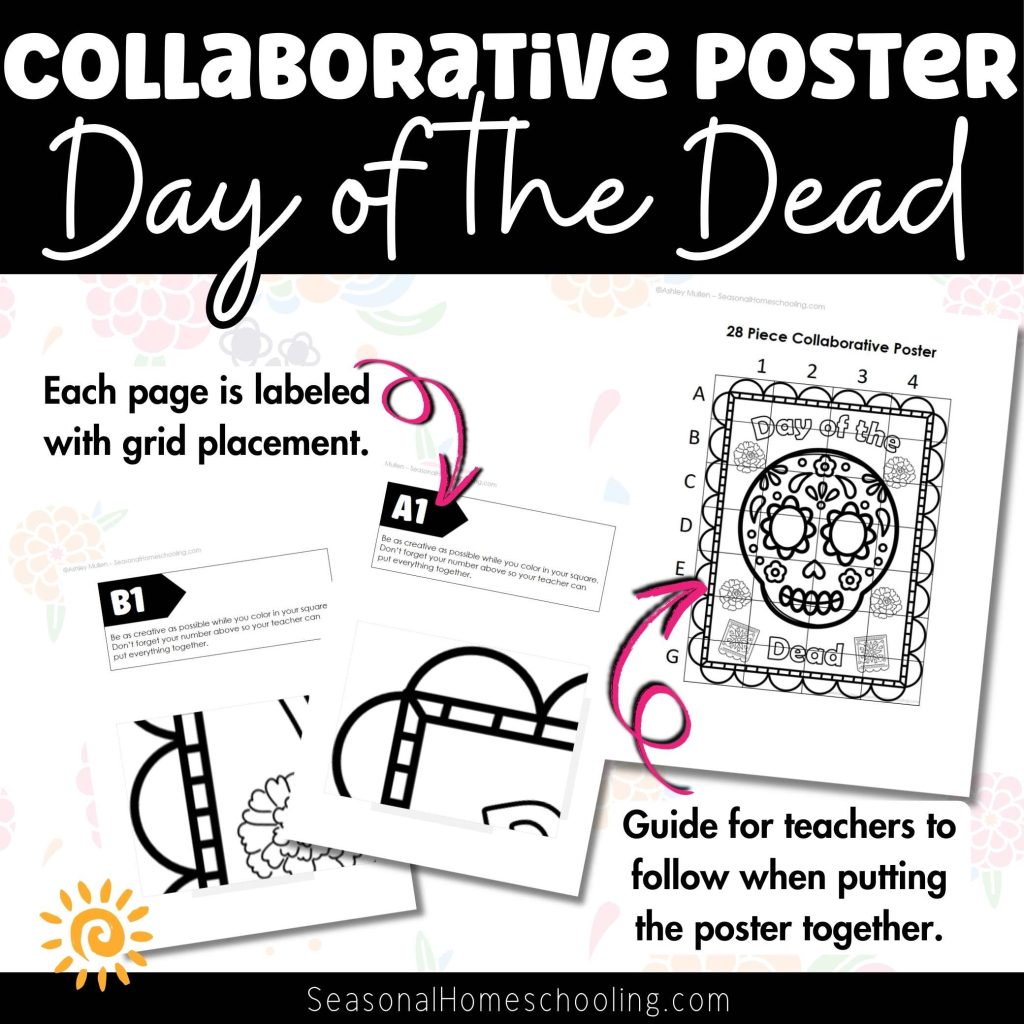

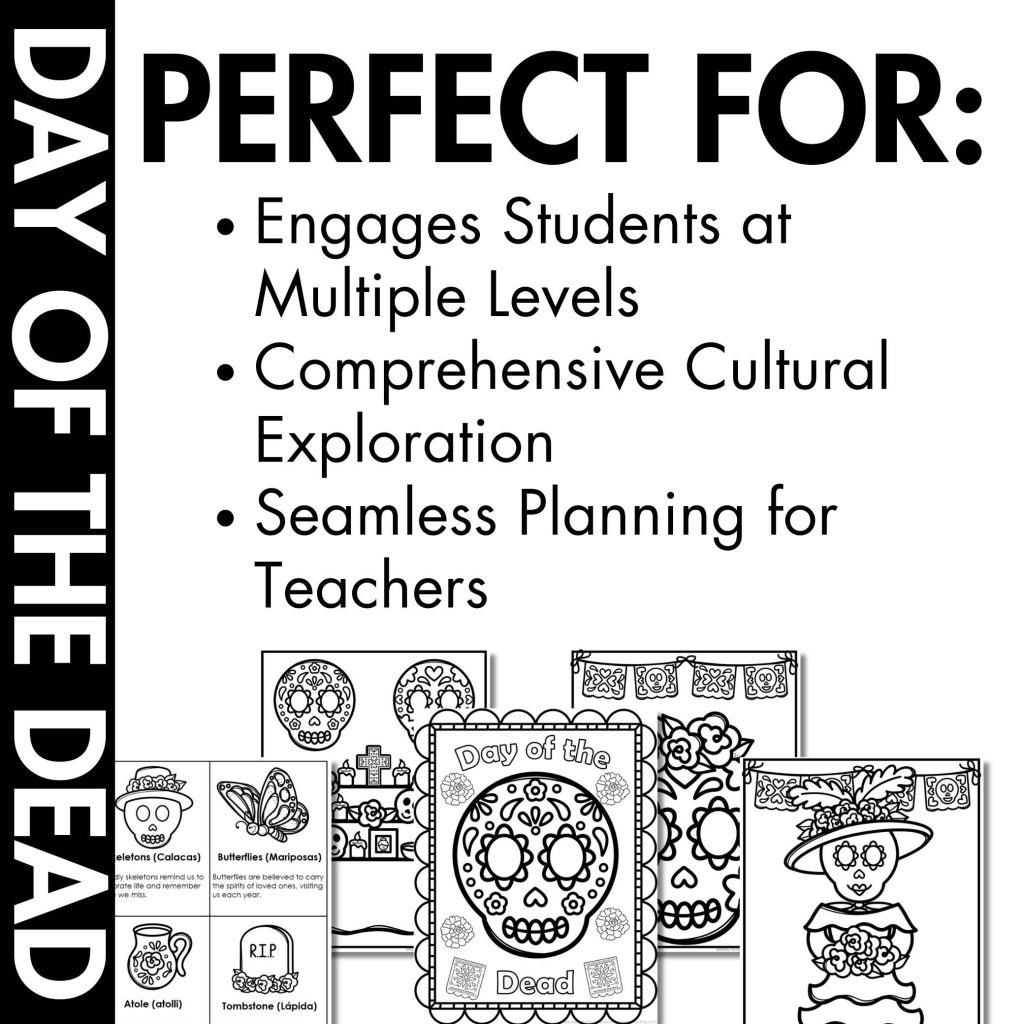
Day of the Dead Bundle Collaborative Poster, Unit Study, and Worksheets
Bring the vibrant traditions of Día de los Muertos into your classroom with this Day of the Dead Bundle! This all-in-one bundle is designed to immerse students in the history, significance, and artistry of Day of the Dead while fostering creativity, comprehension, and cultural respect.
The Science of November: Weather, Seasons & Nature
November is a wonderful month for seasonal science. Depending on where you live, the landscape may be changing dramatically as autumn gives way to winter.
Children can observe these changes firsthand and connect everyday experiences with scientific concepts.
Some interesting November science topics include:
- Why days become shorter as winter approaches.
- How temperatures change throughout the fall.
- Why some animals migrate.
- How animals prepare for winter.
- What happens to trees when leaves fall.
- How frost forms.
- The difference between weather and climate.
Learning activities to try:
- Keep a daily weather observation chart.
- Record sunrise and sunset times and compare daylight hours.
- Research an animal that migrates for the winter.
- Explore how different animals prepare for colder temperatures.
- Collect and compare fallen leaves.
- Investigate how frost forms using a simple science experiment.
- Create a seasonal nature journal with drawings and observations.
These activities are especially useful because children can connect what they are learning with changes they can actually see happening around them.




Winter Animal Habitats & Adaptations Unit Study
Introducing our Winter Animal Habitats and Adaptations Unit Study — an immersive educational experience designed to captivate and inspire young minds. Dive into the frozen wonders of the Arctic Tundra, Antarctic Ice Shelf, and the Taiga, exploring the unique adaptations that enable animals to thrive in winter’s embrace.
Migration: Following the Journey of Animals
As temperatures change and food becomes less available, many animals travel to new locations to find suitable conditions.
Animal migration makes an excellent November science and geography study because it connects animal adaptations, habitats, weather, and map skills.
Some animals worth investigating include:
- Monarch butterflies.
- Canada geese.
- Humpback whales.
- Caribou.
- Arctic terns.
- Gray whales.
Learning activities to try:
- Choose a migrating animal and research its journey.
- Trace an animal’s migration route on a map.
- Compare the distances traveled by different migrating animals.
- Investigate why animals migrate and what challenges they face.
- Create an animal migration fact file.
- Explore how seasonal changes affect animal habitats.
For an additional geography connection, have children locate the places where an animal begins and ends its migration. They can identify continents, oceans, countries, and other geographic features along the way.
Early Winter & Arctic Animals
In many northern regions, November marks the beginning of colder weather and the gradual transition into winter.
This makes it a natural time to introduce children to Arctic habitats and the animals that survive in some of the coldest environments on Earth.
Some interesting topics include:
- What makes the Arctic different from other environments?
- How do polar bears survive in cold temperatures?
- What is the difference between the Arctic and Antarctica?
- How do Arctic foxes adapt to seasonal changes?
- What are sea ice and permafrost?
- How do people and communities live in Arctic regions?
Learning activities to try:
- Compare the Arctic and Antarctic using a Venn diagram.
- Research an Arctic animal and identify its adaptations.
- Locate the Arctic Circle on a map or globe.
- Investigate how blubber helps some animals stay warm.
- Create a food web showing relationships between Arctic animals.
- Explore how seasonal daylight changes in polar regions.
This theme can easily become a larger science and geography unit, especially for children who enjoy learning about animals and unusual environments.

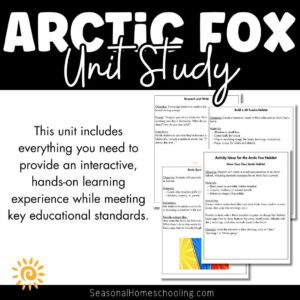
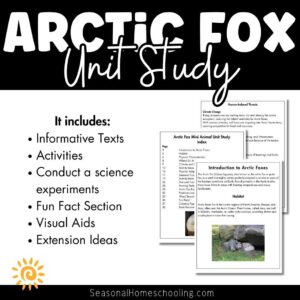
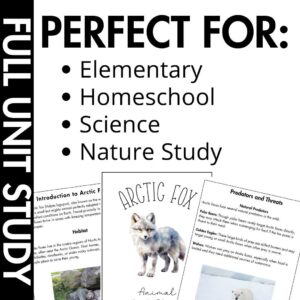


Arctic Fox Unit Study | Science and Literacy Activities for Elementary Grades
Dive into the icy world of Arctic foxes with this comprehensive unit study designed for grades 3-5! Perfect for science lessons, this resource combines engaging activities, detailed explanations, and creative projects to teach students about the fascinating lives of Arctic foxes and their role in the Arctic ecosystem.
Harvest, Farming & Where Our Food Comes From
November is also a wonderful time to explore agriculture and the journey food takes before reaching our tables.
Many communities celebrate the end of the growing season with harvest festivals and seasonal traditions. Children can learn about farming, food production, and how weather and geography influence what grows in different parts of the world.
Some topics to explore include:
- How crops are grown and harvested.
- The difference between seasonal and year-round crops.
- How farmers prepare fields for winter.
- Where common foods originate.
- How food is transported and distributed.
- The importance of soil, water, and weather in agriculture.
Learning activities to try:
- Research how one familiar food is grown.
- Create a farm-to-table diagram.
- Compare crops grown in different climates.
- Learn about the parts of a plant that we eat.
- Plan a seasonal meal using locally available ingredients.
- Explore how farming has changed over the last 100 years.
A farm-to-table study is a great opportunity to combine science, geography, history, and practical life skills.

Plants, Gardening & Harvest Science for Grades 3–5 | Garden Unit Study
Plants, Gardening & Harvest Science for Grades 3–5 is a printable spring science unit that introduces upper elementary students to plant science, gardening concepts, and food systems through engaging, hands-on learning. This life science, garden unit study is designed for Grades 3–5 and works beautifully for classroom instruction, homeschool learning, and garden-based education.
Famous Historical Figures & November History
November is also a great month to explore people and events that have shaped history.
Instead of studying historical figures as isolated names and dates, introduce children to the people behind the stories. What did they do? What challenges did they face? How did their actions affect the world?
Some November-related historical topics include:
- Marie Curie: Born November 7, 1867. Explore her scientific discoveries and contributions to our understanding of radioactivity.
- Robert Louis Stevenson: Born November 13, 1850. Discover the author behind classic adventure stories such as Treasure Island.
- Elizabeth Cady Stanton: Born November 12, 1815. Learn about her role in the women’s suffrage movement.
- The End of World War I: Explore the November 11, 1918 armistice and why it became an important date of remembrance.
- The Fall of the Berlin Wall: Learn about the events of November 9, 1989, and how the wall’s fall became a symbol of change in Europe.
Learning activities to try:
- Create a historical figure biography page.
- Build a timeline of important November events.
- Locate historical events on a world map.
- Read a biography or historical picture book.
- Write a short newspaper article reporting on a historical event.
- Compare how life was different before and after an important invention or historical change.
These studies can be adapted to different elementary ages by adjusting the reading material, research expectations, and writing activities.
November Literature & Story-Based Learning
November is also a lovely time to bring seasonal literature into your learning routine.
Books provide a natural starting point for discussions, creative writing, vocabulary development, and cross-curricular connections.
Choose stories connected to autumn, gratitude, historical events, animals, or seasonal changes.
After reading, try extending the story with a few simple activities:
- Identify the characters, setting, and problem.
- Retell the story in your own words.
- Write an alternative ending.
- Create a new character for the story.
- Draw a scene and write a descriptive paragraph.
- Compare the setting in the story with your own surroundings.
- Research a real-world topic introduced in the book.
Story-based learning is particularly useful for elementary students because it gives them a meaningful context for reading, writing, and exploring new ideas.
Making November Learning Meaningful
November is full of opportunities to explore history, culture, science, and the changing seasons. Whether you’re studying Thanksgiving, learning about Remembrance Day, following animal migration routes, or discovering how different communities celebrate and remember, there’s plenty to keep elementary learners curious.
The best part about seasonal learning is that it doesn’t have to involve an elaborate schedule or a completely different curriculum. Sometimes a good book, an interesting question, a simple experiment, or a conversation about something happening in the world around us is enough to get learning started.
Choose topics that interest your children or students, follow their curiosity, and look for opportunities to connect what they’re learning with everyday life.
A little seasonal inspiration can go a long way!
Looking for more seasonal learning ideas? Explore the Seasonal Homeschooling collection for unit studies, writing activities, and printable resources designed to make elementary learning engaging throughout the year.


